
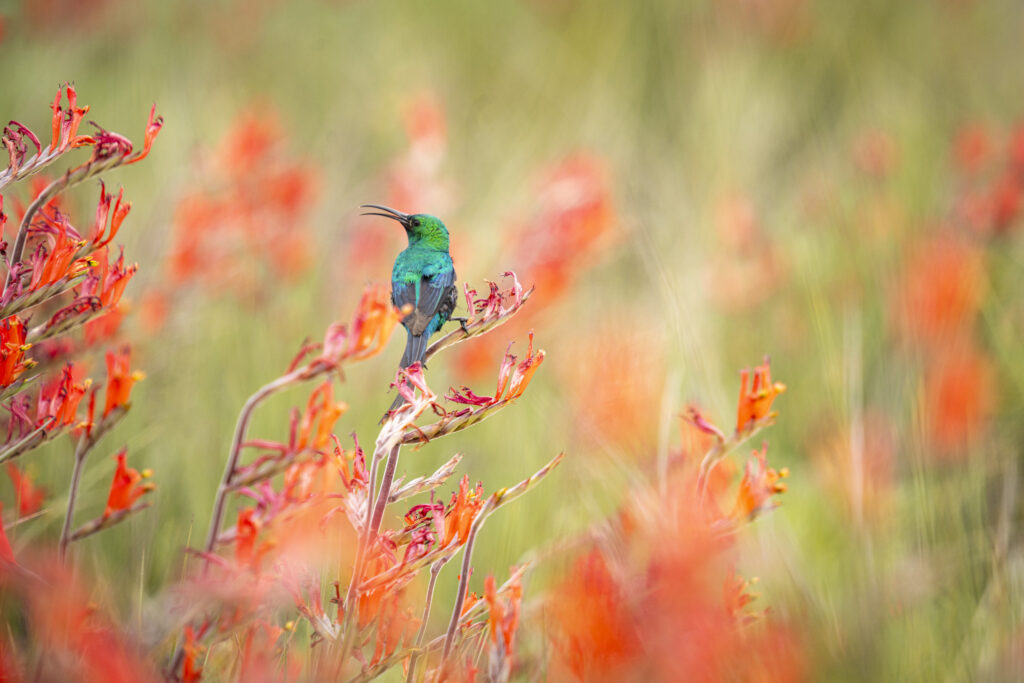
The birdlife at Naries Namakwa Retreat is very much interwoven into the dramatic landscape of this part of the Northern Cape Province. The management team at this premium outdoor destination has decided to establish avian tourism as one of their key USPs, and are currently planning a Birding Trail, as well as a new bird hide.
Naries promises an unforgettable birding experience, allowing visitors total freedom to walk, drive or cycle within the 7500ha private reserve in search of more than 170 identified species. Professional birding guides will consistently be adding to this comprehensive list, and can also be hired to accompany guest keen on experiencing the wider region.
We have highlighted a NARIES TOP 10 LIFER LIST below, with details on rare and endemic species. Keep an eye out for the Ant-eating Chat and the elusive Burchell’s Courser, or Black Harriers gliding through the skies at the northern edge of its range. The Cape Clapper Lark is a highlight, known for its remarkable display, alongside the ever-present Stark’s Lark.
As the day unfolds, the evocative call of the Namaqua Sandgrouse becomes part of the Northern Cape’s rhythm. The majestic Black Stork cuts a striking figure, and overhead, the Alpine Swift – the largest of the swifts – sweeps effortlessly through the air.
The rugged rocky outcrops offer a perfect habitat for the Short-toed Rock Thrush, and they stand out thanks to their impressive slate-grey and russet plumage. And of course, no visit is complete without a sighting of the Cinnamon-breasted Warbler, a true gem in this rugged landscape.
THE NARIES TOP 10 LIFER LIST:
A Preliminary Overview of Rare and Endemic Birds1. Ant-eating Chat
Afrikaans: Swartpiek
Myrmecocichla formicivora
A striking brown and black common endemic Chat of the open grasslands and semi-arid shrublands.
What to look for:
Dark brown plumage with distinctive white wing patches visible in flight.
18cm
Flies with rapidly beating piebald wings, often swerves searching for prey. Hovers before dropping to the ground to feed on Ants or termites.
Call:
A cheerful jumble of whistling and rasping notes
Tee-a-u,tee-a-u,
The second tee can be drawn out and the a-u a lower pitch
A clear plaintive whistled peeeekalarm call.
2. Burchells Courser
Afrikaans: Bloukopdrawwertjie
Cursorius rufus
An uncommon near-endemic of sparsely vegetated arid regions. Runs rather than flies when disturbed. Search for this gem in the shade of the bushes in the heat of the day.
What to look for:
21cm
The narrow black stripe behind the eye distinguishes it from Temmincks Courser.
Black bar on belly is slightly in front of the legs,
White tipped secondaries visible in flight
Call:
Grating short kok-kok and chuck-chuck notes
3. Black Harrier
Afrikaans: Witkruisvleivalk
Circus maurus
Here at the northern limits of its range this uncommon near threatened endemic is usually found singularly in Fynbos, renosterveld, karroo shrublands, dry grasslands and croplands.Look out for this black harrier perched on posts or hunting low over the vegetation, especially on windy days.
What to look for:
51cm
Black with bold tail barring (black and white) Pied plumage is unmistakeable when viewed from below.
Legs and feet yellow
Call:
Frequently heard whistling psiew-psiew-psiew call from the female.
Displaying males call is a high squeal prrrrep
4. Cape Clapper Lark
Afrikaans: Kaapse Klappertjie
Mirfra apiata
A fairly common smallish compact, quail like endemic Lark. Can be secretive, running along the ground between densely vegetated dwarf scrublands. Displaying Males are conspicuous, rising steeply from the ground while clapping his wings, on the descent he whistles while parachuting down.
What to look for:
12-14cm
Sexes alike, small compact Lark with barred plumage reminiscent of a quail. Fast wing clapping display flight.
Crown Rufous
Face rather plain with creamy white supercilium
Flight feathers Grey-brown
Call:
Male sings early morning and evening in breeding season, often at night.
Simple Tseeuuu whistle on the descent.
5. Starks Lark
Afrikaans: Woestynlewerik
Spizocorys starki
Locally common near-endemic showing pallid colouration, pale bill and an erectile crest. Often associates with Grey Backed Sparrow-larks and Lark-like buntings
What to look for:
13-14cm
Small Pallid Lark with large pale bill and erectile crest
Sexes alike.
Teardrop under the eye
Flight feathers are dark brown, white underparts with a buff wash.
Call:
A long rambling series of mellow churring chirps and whistles.
Chirr-chirr-chree-chree-chirr-chirr-chirrchree-chree
Flight call a soft chop chop
6. Namaqua Sandgrouse
Afrikaans Kelkiewyn
Pterocles Namaqua
Common near-endemic that will fly in search of water 1-2 hours after sunrise. A brownish olive Sandgrouse with an unmistable “kelkiewyn” call.
What to look for:
26cm
Male: Head, mantle and breast yellowish olive. Throat and forehead yellower.
Double breast band of white and deep maroon.
Belly dark brown
Female: Head and upper breast vertically streaked dark brown and buff.
Throat plain yellowish.
Upper breast streaked dark brown, lower breast and belly transversely barred brown and buff
Call:
A loud nasal Ki-Ki-vee (kelkiewyn) repeated at short intervals in flight and as contact call on ground.
7. Black Stork
Afrikaans: Groot swart ooievaar
Ciconia nigra
A nomadic uncommon resident Stork with striking bold black plumage and a red bill and legs. Often found around pans, flood plains and dams that contain fish
What to look for:
103cm
3kgs
Red bill and legs
Black rump visible in flight
Underparts white with striking Black plumage which shows a glossy greenish purple sheen during the breeding season
Call:
Silent when not breeding
High pitched whistling calls given at nest sites
8. Alpine swift
Afrikaans: Witpens windswael
Tachymarptis melba
A large swift resident in the Northern Cape. Only swift in the region with white underparts and brown breast band, feeding n many habitats and mountainous areas.
What to look for:
20cm
Fairly uniform olive brown upperparts with chin and throat white separated from white mid breast by olive brown breast band, leaving lower breast and belly white.
Large and unmistakable
Call:
A trilling call in flight
9. Short-toed rock thrush
Afrikaans: Korttoonkliplyster
Monticola brevipes
A handsome near-endemic found on rocky outcrops and inselbergs or escarpments. Often on flat ground during winter.
What to look for:
18cm
Whitish forehead and crown distinctive. Blue grey plumage isolated to the throat. Mantle and back blue grey
Rump and upper tail coverts rich rufous -orange
Female throat whiter than male and speckled brown
Call:
A series of clear, jumbled, whistled phrases that can include mimicry.
10. Cinnamon-Breasted Warbler
Afrikaans: Kaneelborssanger
Euryptila subcinnamomea
A common endemic found singly, in pairs or small family groups around Granite Inselbergs, boulder strewn hillsides and mountain sides with low shrubs and grasses.
What to look for:
13-14cm
Forecrown bright cinnamon or chestnut
Mid-crown to rump warm russet
Face speckled black n white
Flight feathers brown
Lower belly blackish grey
Call:
Pair call together
1 gives ascalding CHWEE-CHWEE-CHWEE other gives a long, rising whistle POOWEEEE,
Also plaintive eeee
Ref: Roberts VII TEXT
For more information, feel free to contact Colin Wylie on +(27-82) 575 5970